Welcome to the Fort Lewis College Sky Steps Horizon Calendar
What is a horizon calendar?
A horizon calendar is an ancient observational timekeeping method for tracking the seasons and time of year by noting the position the Sun rises or sets on the horizon. The first thing to know to understand how a horizon calendar works is that the Sun rises (and sets) in a slightly different position almost every day of the year. A horizon calendar works year after year because the sunrise and sunset positions for every day of the year are predictable. For example, if you make your observation from the same location, the Sun will rise (or set) in the exact same location every year on your birthday.
People made horizon calendars before the invention of the modern calendar, by noting the location of sunrise or sunset regularly, likely over multiple years. By noting the location on the horizon where the Sun rose (or set) when important events occurred, these events could be predicted in future years by watching for time when the sunrise (or sunset) position was nearing that location on the horizon.
How does a horizon calendar relate to the 250/150 project?
The 250/150 project is about understanding our sense of place. Cultures from the Four Corners region have used horizon calendars for over a thousand years. By following along with the content below, you will learn how a horizon calendar works by using this example from the Fort Lewis College campus. Our hope is that you create your own horizon calendar where you live. Before the invention of the modern calendar where we can just look up the date on our phones, our ancient relatives relied on this knowledge to live!
Safety message: If you plan to observe sunsets (or sunrises) at the Sky Steps or anywhere else, take care. Looking directly at the Sun is bad for your eyes. Your goal when observing the Sun’s setting or rising position is to notice the general area where this occurs, not the precise location. The safest time for sunrise is just as the Sun is beginning to be visible. The safest time for sunset is just as the Sun is finally disappearing over the western horizon or just after it sets and sky still glows where the Sun had set.
How a horizon calendar works.
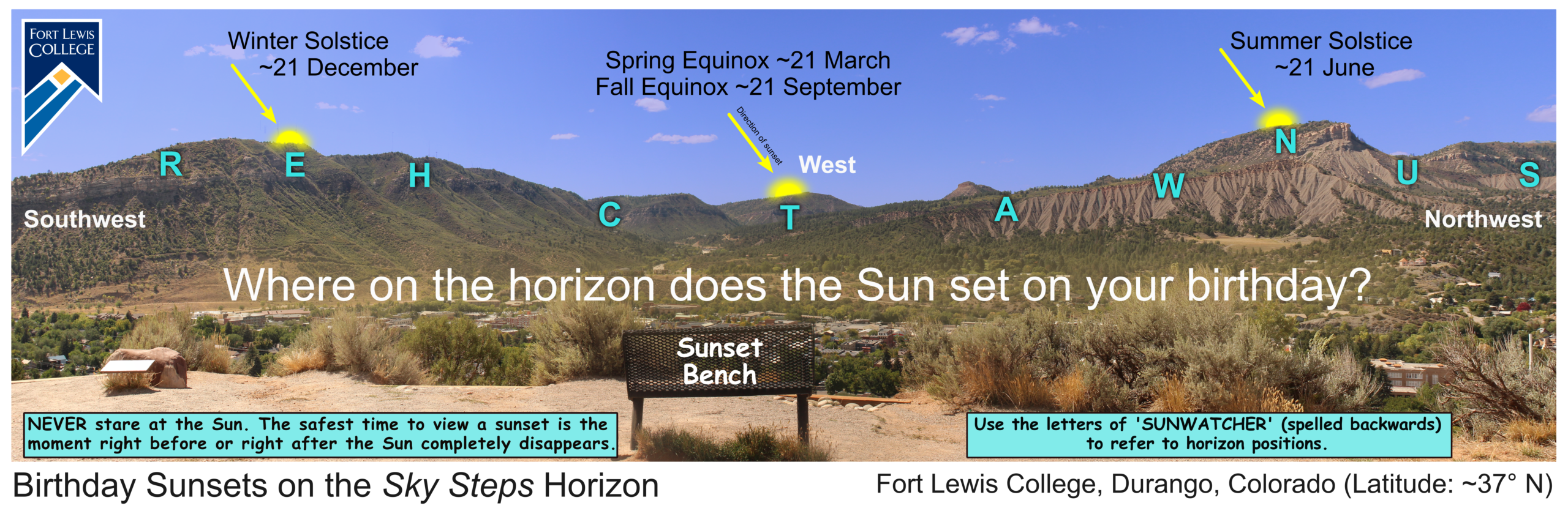
Let’s get started. First, look at the Birthday Sunset Activity Poster shown here.
For the poster shown here, where do you think the Sun would set on your birthday?
On the Birthday Sunset Activity Poster, the turquoise letters of the word “SUNWATCHER” (spelled backwards) are just there to help us refer to places on the horizon above them. Use these letters to share your estimate of where on the horizon the Sun sets on your birthday. Sample answers could be, “at horizon position A” or “Between horizon positions A and T”.
Here are some tips to help you with the BIRTHDAY SUNSET ACTIVITY POSTER:
- The photos from this panorama were taken from just behind the black bench at the top of the Sky Steps on the Fort Lewis College campus.
- The yellow disks mark the horizon positions of sunset on the Winter and Summer solstices and the Spring and Fall Equinoxes when observed from the top of the Sky Steps.
- The slanted arrows pointing to the Sun disks mark the end of the Sun’s longer path across the sky shortly before it sets on the labeled date.
- Sunsets that occur northward (right) of west occur on days when the Sun climbs higher and spends more time in the sky. These are days with more hours of daylight than nighttime [see the higher, red dotted line path in Sun Motion Diagram below].
- Sunsets that occur southward (left) of west occur on days when the Sun stays lower and spends less time in the sky. These are days with fewer hours of daylight than nighttime [see the lower, blue dashed line path in the Sun Motion Diagram below].
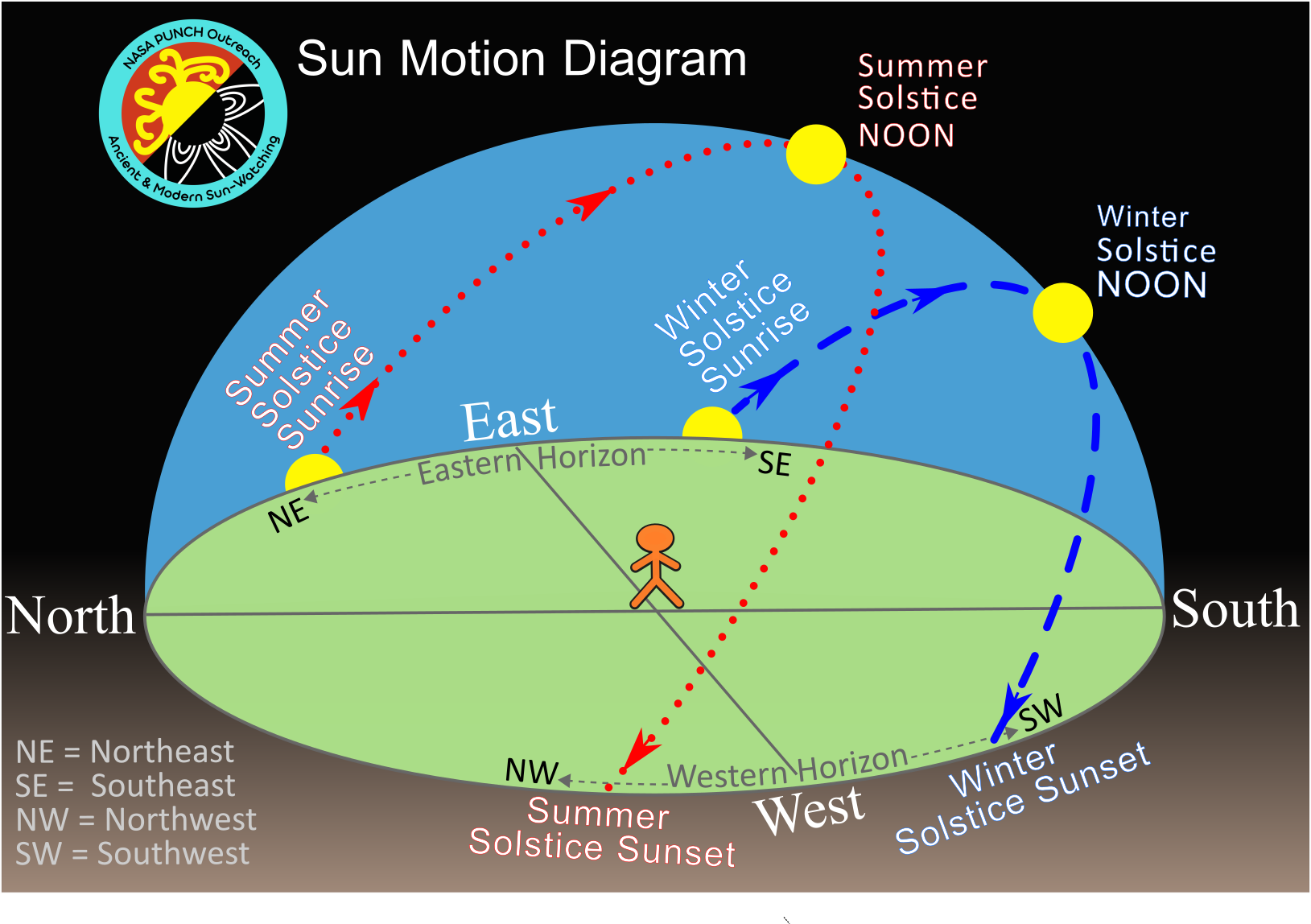
Now that you understand the Sun Motion Diagram better, follow these clues below to understand how the horizon calendar works.
Which horizon position letter marks the direction of due west and the sunset position for the spring AND fall equinoxes?
As the year continues in the fall season, the position of sunset shifts gradually southward (to the left) of west. This shift is along the horizon from position “T” toward position “E”. Which letter marks the horizon position where the Sun sets on the Winter Solstice?
After the December Solstice, the sunset position reverses direction and moves slowly northward (to the right) along the horizon each day. After December, positions of sunset in the months of January and February are moving northward (to the right) toward the Spring Equinox in March. Thus, they must occur between horizon positions “E” and “T”.
After the winter months comes March, and the Spring Equinox. Which letter marks the horizon position where the Sun sets on the Spring Equinox?
The sunset positions for late March through early June occur between horizon positions “T” and “N”.
The horizon position where the Sun sets on the Summer Solstice is marked by which letter?
The positions of sunset for late June through early September occur to the left of horizon position “N”, between letters “N” and “T”. Yes, these are the same places the Sun set for late March through early June.
We are now back at letter “T” for the Fall Equinox again.
To be sure you see how this works, watch this one-minute video.
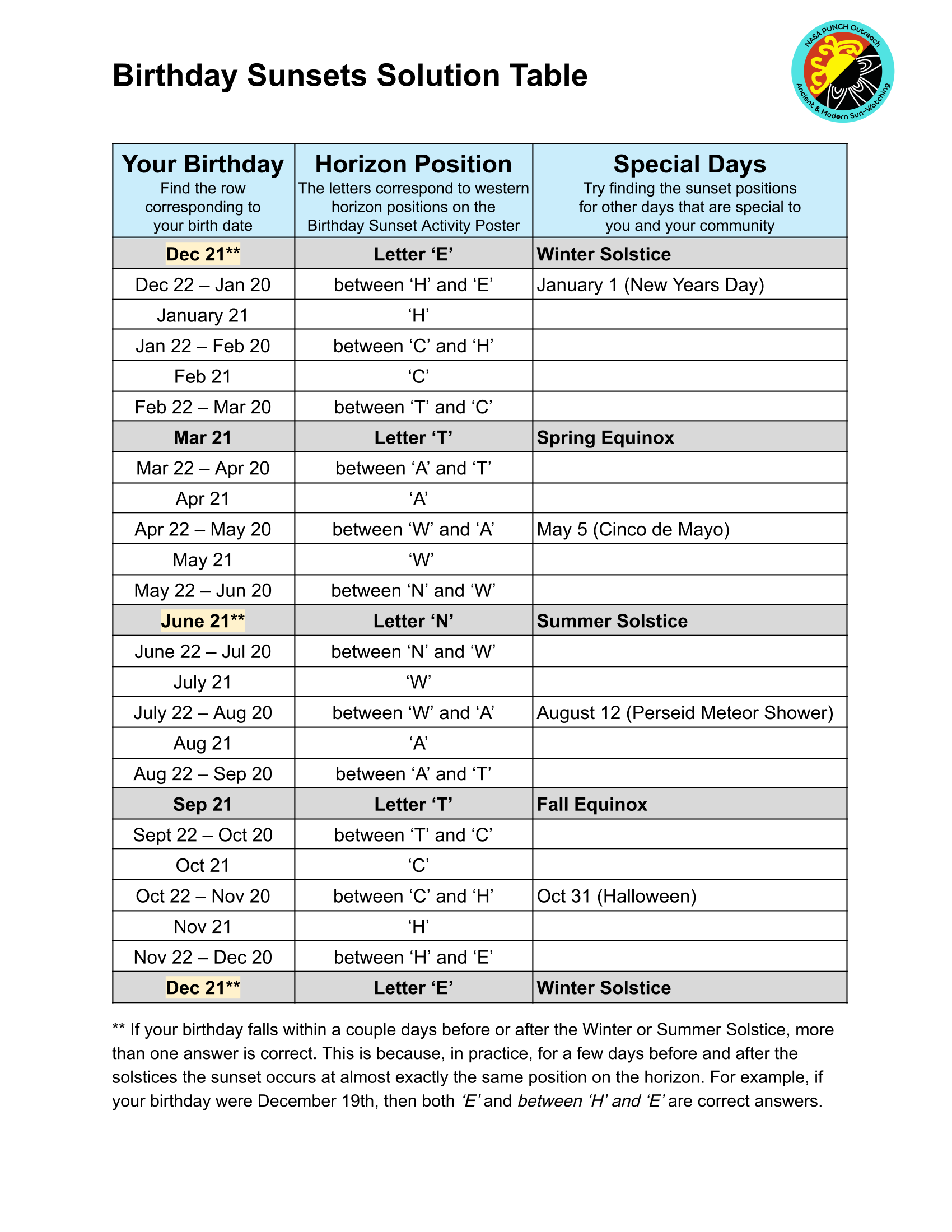
To see if your birthday location prediction was correct, look at the diagram below. This diagram shows which days of the year match with which horizon position letters.
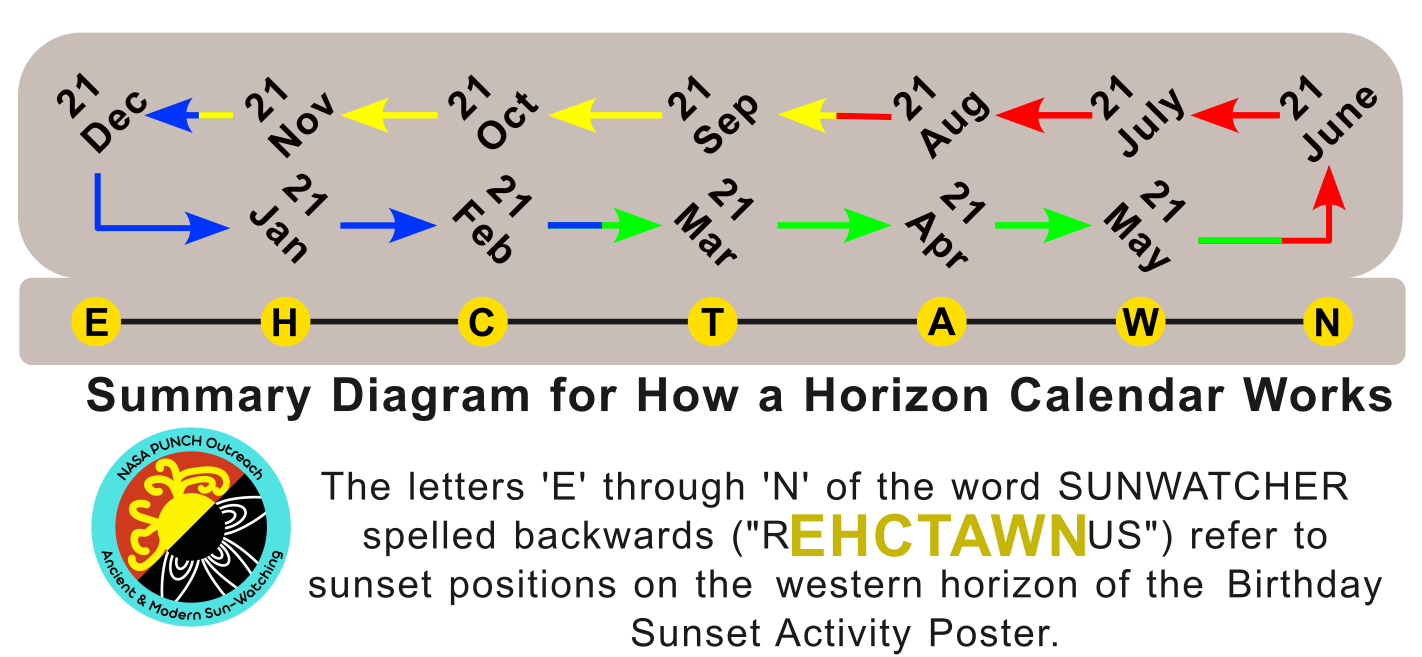
If you think you understand the horizon calendar, you can test yourself by proposing other days of the year. Look at the table below to see if you are right.
Want to learn more? Click here to see more about NASA’s PUNCH mission. You can test your new knowledge on a horizon calendar for Chaco Canyon, NM.
Letter “T”.
The answer is letter “E”. Note that the Sun NEVER sets farther southward (to the left) of letter “E” as seen from this viewpoint.
The position of sunrise (and sunset) on the horizon changes a little bit each day over the course of a year. There are no big jumps. Each day near the Equinoxes, the sunrise position can change by almost the entire width of the Sun’s disk. The sunrise position near the Solstices hardly shifts at all, so that from one day to the next, we can hardly tell that the position has changed.
The days near Winter Solstice are when the Sun’s path from sunrise to sunset is the lowest in the sky and we have the least amount of daylight.
Horizon position “T”.
The sunset positions are about the same for March 21st and September 21st. We are back to a time of year with equal amounts of time the Sun is above and below the horizon each day.
The answer is letter “N”. Note that the Sun NEVER sets farther northward (to the right) of letter “N” as seen from this viewpoint.
Near the Solstices, the sunset positions change more slowly than near the Equinoxes. This is why the horizon letters are spaced closer together near the Solstices.
The days near Summer Solstice are when the Sun’s path from sunrise to sunset is highest in the sky and we have the greatest amount of daylight.